A 10-year-old aerospace test station, the original integrator winding down for retirement, password-locked subVIs, and aging hardware about to fail. Here's how we replicated the system and modernised it without losing CMM compliance.
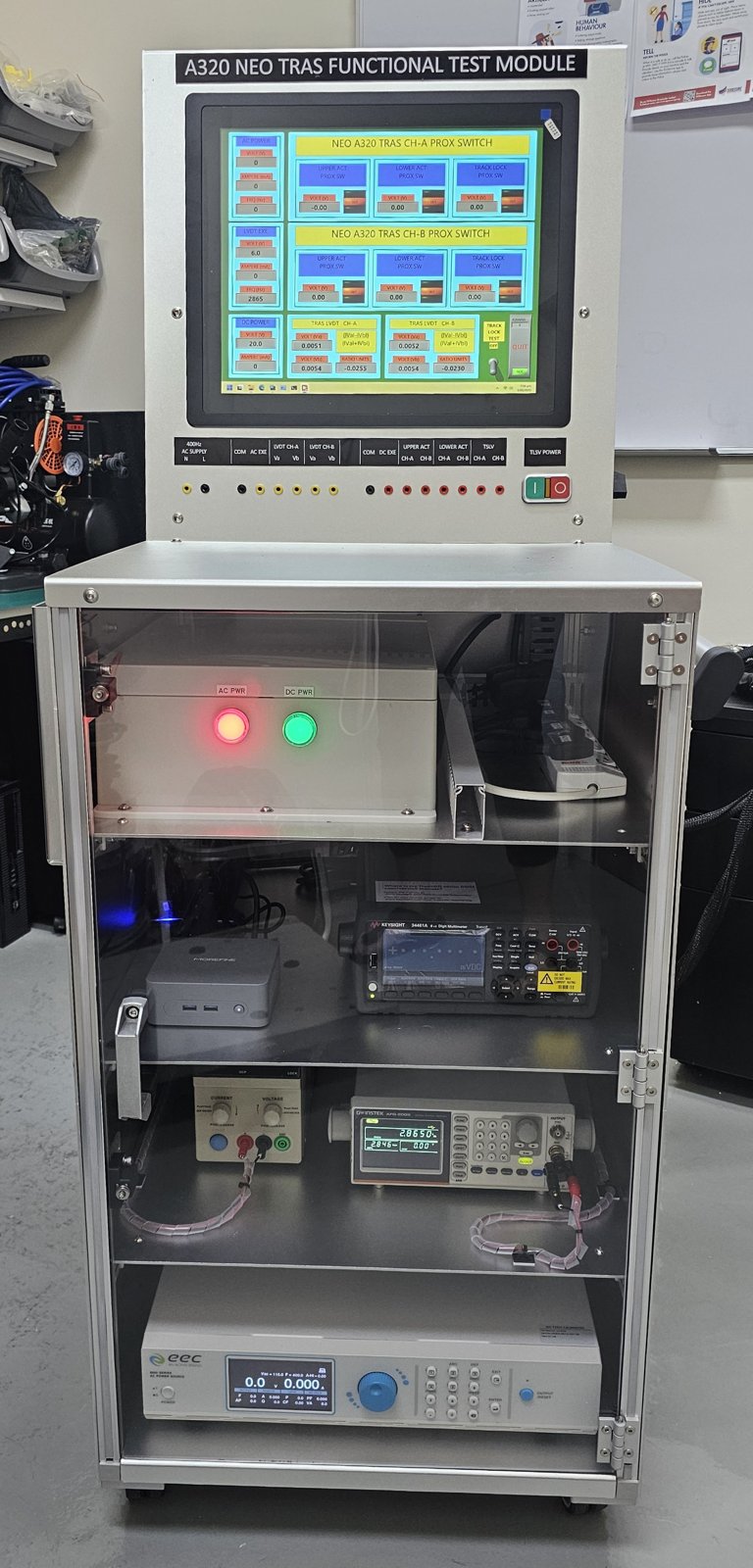
An aerospace client had been running a functional test station for an A320 Neo thrust-system module for about ten years. The station was the only way they could verify that specific assembly before it shipped, and the test sequence was defined against the aircraft maintenance documentation. It worked — but three things had quietly become problems:
The client's ask was straightforward in principle and fiddly in practice: "Replicate this system. Make sure it still passes the same test exactly the same way — but put it on modern hardware we can actually maintain."
The client had preserved some of the original documentation from a decade earlier — wiring notes, a partial schematic, and a general architecture diagram. Useful, but incomplete. We validated what was still accurate against the physical rig, traced the missing parts cable by cable, and rebuilt the schematic end-to-end so the client owned a clean, current reference. That diagram became the single source of truth for every downstream decision.
The existing application was a full LabVIEW codebase. Several of the subVIs had been password-locked by the original vendor, and with the vendor preparing for retirement that was not going to change. We treated those blocks as black boxes: observed their inputs and outputs on the live system, cross-referenced the expected behaviour against the CMM, and re-implemented each one from scratch in new, open VIs. The rewritten codebase is fully readable by the client — no locked blocks, no hidden logic, no dependency on someone else's password.
The EOL AC power supply and function generator were swapped for current-generation equivalents with the same (or better) performance envelopes. Every replacement was checked against the tolerances the CMM specifies — not against the old unit's datasheet. That's an important distinction: we were preserving the test, not the specific instrument that originally ran it.
Once we had a clean schematic, we rebuilt the control box with new terminals, fresh wiring, labelled loom, and current-generation DAQ. The pinout and signal routing matched the original exactly, so the unit under test sees the same environment it always did. Inside the box, though, it's laid out for serviceability — everything is documented, labelled, and reachable for a technician three years from now.
The rewritten LabVIEW application runs on a new industrial PC with a supported OS, current drivers, and a backup image the client actually has. Spare machines are drop-in. The old PC is retained as a reference for one more year, then retired.
The temptation with a legacy station is to clone it bolt-for-bolt. We've learned to resist that. What the regulator and the client care about is that the test is still the test — the same sequence, the same tolerances, the same pass/fail decision. Cosmetic fidelity to a 10-year-old implementation buys nothing; it just re-imports the EOL problems you were trying to solve.
On a system this old, the most valuable thing we did in week one was draw it. Once the wiring, signal paths, and software flow were written down in a form anyone on the team could read, every later decision was faster and safer. The client now owns that documentation — which is, honestly, half the point of commissioning us.
Password-locked subVIs are a common artefact of long-running vendor relationships, and they're not always anyone's fault. In this case the original engineer was simply retiring; he was happy for us to take it on, just not in a position to come back and unlock things. The pragmatic path is the same either way: observe the behaviour, re-derive the logic from the underlying spec, and write a clean open implementation the client can see into. That's what we did here, and it's what we'd do again.
Every industrial client we talk to has at least one rig in a corner that nobody wants to touch — because it works, it's old, and the person who built it isn't around any more. Replication with modernisation is one of the more common jobs we take on. It's not glamorous work, but it's the kind of work that buys a client another ten years of production without a rewrite every quarter.
Got a station that fits the description? Tell us about it. We'll give you a straight read on whether a replication, a modernisation, or a full rebuild is the right move.
Send us a photo and a paragraph. We'll come back with an honest plan.