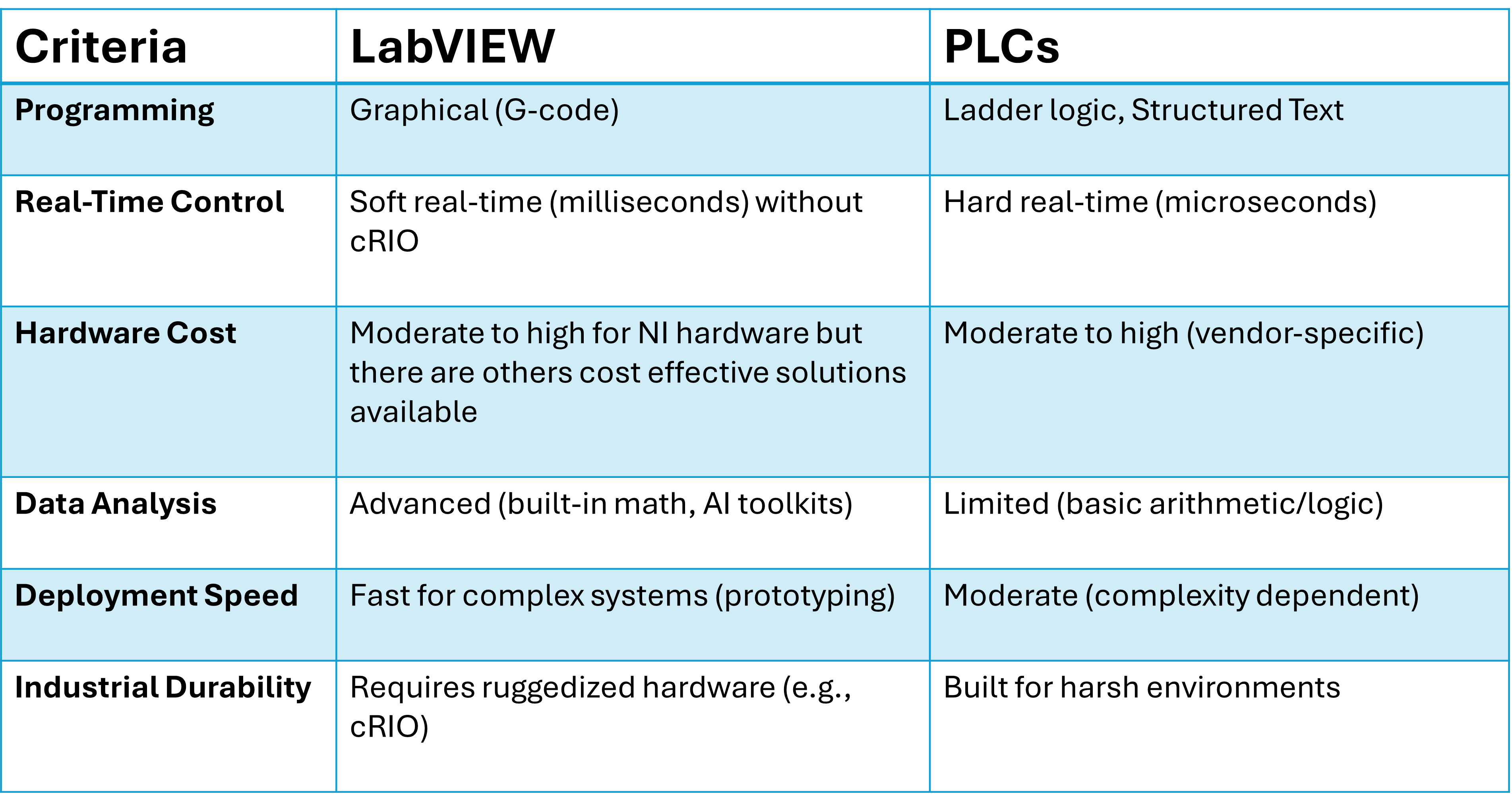
"Should we use LabVIEW or a PLC?" is one of the first questions we get on a new project. After enough deployments across aerospace, semiconductor, and Smart Nation infrastructure, the honest answer is: both, with a clear division of labor.
Typical LabVIEW jobs: semiconductor QA rigs, HDB waste-chute data aggregation (200–900 sensors), solar efficiency monitoring, aerospace functional-test stations like our A320 Neo thrust-engine module.
Typical PLC jobs: conveyors, robotic arms, offshore rig control, SIL-rated interlocks, harsh-environment production lines.
On most projects: PLCs run the control loops (safety, motion, real-time I/O). LabVIEW handles data, test sequencing, and UI (multi-instrument coordination, results database, reports). Middleware bridges them — Modbus TCP for the basics, OPC-UA for structured models, MQTT for cloud or Smart Hub integration.
There's no universal answer. Tailor the choice to determinism, data ambition, environment, and — most underrated — who will maintain the system five years out.
Mid-decision and want a second opinion? Talk to us.
Send us a one-paragraph description of the system. We'll come back with a straight read.